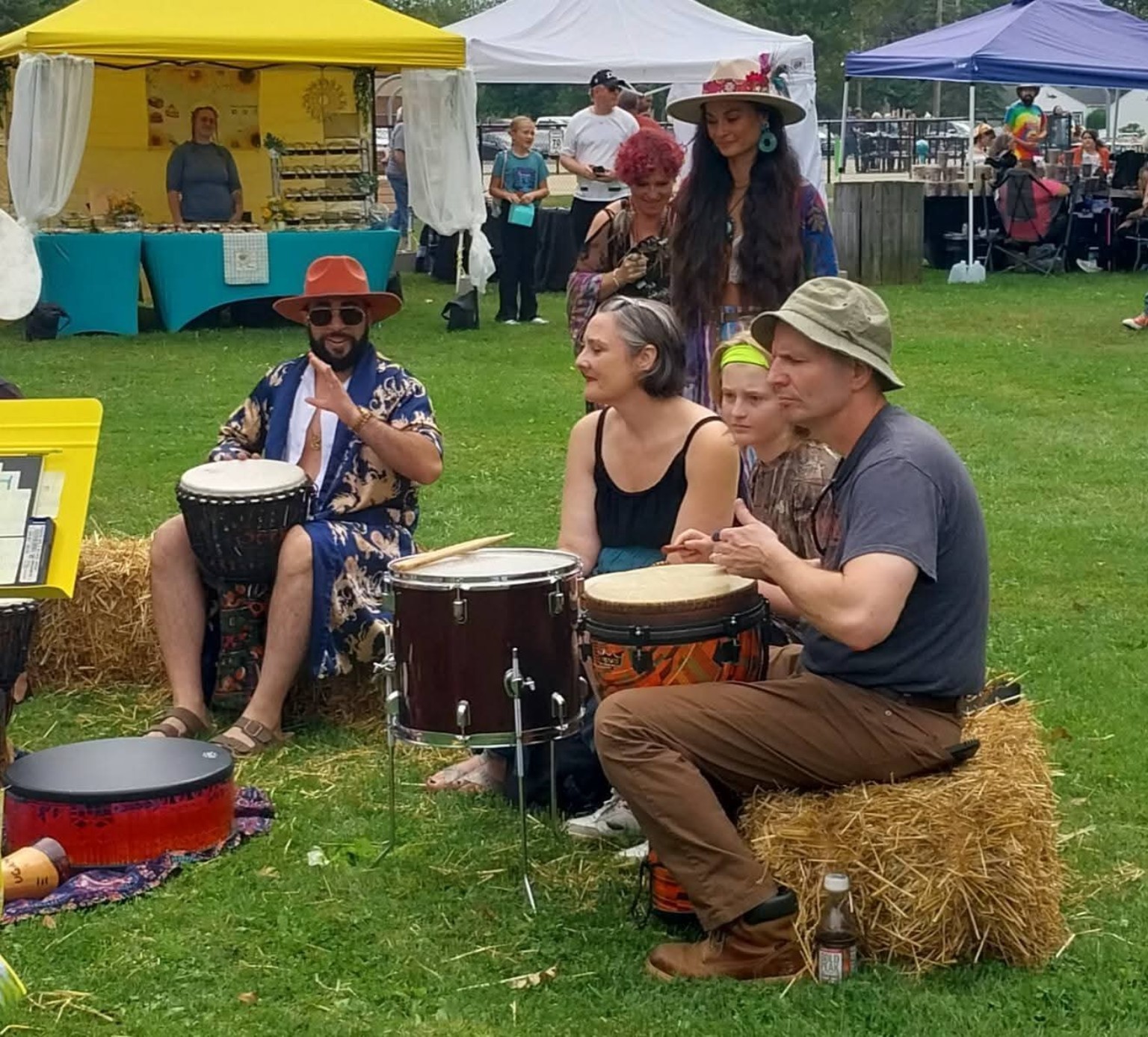
They’re not just for Credence Clearwater Revival parking lots anymore!
In fact, there is an ever growing body of research pointing to the health benefits of drum circles across a wide variety of populations.
The great news is that over the past few years, we’re seeing an uptick in the number of studies coming out about how group drumming helps people.
The range of uses spans the fields of neuroscience, mental health, geriatric medicine, and substance abuse recovery to name just a few.
This is a short list (there’s much more out there!) of 10 peer-reviewed research for you for two reasons:
- It’s helpful to have a few legitimate scientific factoids top of mind so that you can share them during your events. Doing so helps to shift the stereotype of drum circles away from being a “new age” or a “hippie activity” (not that there’s anything wrong with either of those!) and towards being a scientifically valid modality that has been shown to help people - and with the data to prove it.
- If you work in a health, corporate or educational profession, it’s easier to get grants and other funding for instruments and training if you can show “data driven” proof of the efficacy of group drumming.
Below are 10 studies from reputable sources – mostly the National Institute of Health.
You’ll find studies on group music making with older adults, veterans with PTSD and other populations.
You’ll discover how rhythmic interactions bond people together, how drumming stimulates neuroplasticity in the brain and improves well-being in people with Dementia among many other benefits.
Feel free to visit the links below, share with anyone and/or copy and paste them for your needs.
Being a leader in a rhythmic interaction activates reward-related brain regions
Interpersonal rhythmic interaction is one of the fundamental behaviors that allow humans to socially interact with others. In this study, we provide novel neuroimaging evidence that being followed by other agents in such an interaction is pleasant for humans. Using functional magnetic resonance imaging, we measured the brain activity of 17 participants while they performed a virtual drum-hitting task, in one of the following conditions: a) alternating with a virtual agent that would always copy their hitting pace, or b) alternating with a virtual agent that would randomly hit the drum. The participants reported a significantly higher subjective feeling of being followed by the agent in the first condition. Moreover, almost all participants preferred the agent that followed their drum-hitting rhythm. The activity of the caudate nucleus, which is one of the reward-related brain structures, was found to be associated with the subjective feeling of being followed, suggesting that the sense of being the leader, in an interpersonal rhythmic interaction, creates a pleasant feeling.
- Interpersonal rhythmic interaction is a fundamental social behavior.
- fMRI was used to measure brain activity during an alternating drum-hitting task.
- Most participants preferred the condition in which their hitting pace was copied.
- The sense of being followed activates reward-related brain regions.
- Being a leader in a rhythmic interaction task might be pleasant for humans.
Read the study
Rhythm in joint action: psychological and neurophysiological mechanisms for real-time interpersonal coordination
Human interaction often requires simultaneous precision and flexibility in the coordination of rhythmic behaviour between individuals engaged in joint activity, for example, playing a musical duet or dancing with a partner. This review article addresses the psychological processes and brain mechanisms that enable such rhythmic interpersonal coordination. First, an overview is given of research on the cognitive-motor processes that enable individuals to represent joint action goals and to anticipate, attend and adapt to other's actions in real time. Second, the neurophysiological mechanisms that underpin rhythmic interpersonal coordination are sought in studies of sensorimotor and cognitive processes that play a role in the representation and integration of self- and other-related actions within and between individuals' brains. Finally, relationships between social–psychological factors and rhythmic interpersonal coordination are considered from two perspectives, one concerning how social-cognitive tendencies (e.g. empathy) affect coordination, and the other concerning how coordination affects interpersonal affiliation, trust and prosocial behaviour. Our review highlights musical ensemble performance as an ecologically valid yet readily controlled domain for investigating rhythm in joint action.
Read the study
Lost in the Rhythm: Effects of Rhythm on Subsequent Interpersonal Coordination
Music is a natural human expression present in all cultures, but the functions it serves are still debated. Previous research indicates that rhythm, an essential feature of music, can enhance coordination of movement and increase social bonding. However, the prolonged effects of rhythm have not yet been investigated. In this study, pairs of participants were exposed to one of three kinds of auditory stimuli (rhythmic, arrhythmic, or white-noise) and subsequently engaged in five trials of a joint-action task demanding interpersonal coordination. We show that when compared with the other two stimuli, exposure to the rhythmic beat reduced the practice effect in task performance. Analysis of the behavioral data suggests that this reduction results from more temporally coupled motor movements over successive trials and that shared exposure to rhythm facilitates interpersonal motor coupling, which in this context serves to impede the attainment of necessary dynamic coordination. We propose that rhythm has the potential to enhance interpersonal motor coupling, which might serve as a mechanism behind its facilitation of positive social attitudes.
Read the study
Motor Learning Induces Plasticity in the Resting Brain—Drumming Up a Connection
Neuroimaging methods have recently been used to investigate plasticity-induced changes in brain structure. However, little is known about the dynamic interactions between different brain regions after extensive coordinated motor learning such as drumming. In this article, we have compared the resting-state functional connectivity (rs-FC) in 15 novice healthy participants before and after a course of drumming (30-min drumming sessions, 3 days a week for 8 weeks) and 16 age-matched novice comparison participants. To identify brain regions showing significant FC differences before and after drumming, without a priori regions of interest, a multivariate pattern analysis was performed. Drum training was associated with an increased FC between the posterior part of bilateral superior temporal gyri (pSTG) and the rest of the brain (i.e., all other voxels). These regions were then used to perform seed-to-voxel analysis. The pSTG presented an increased FC with the premotor and motor regions, the right parietal lobe and a decreased FC with the cerebellum. Perspectives and the potential for rehabilitation treatments with exercise-based intervention to overcome impairments due to brain diseases are also discussed.
Read the study
Music Therapy for Posttraumatic Stress in Adults: A Theoretical Review
Read the study
Making music for mental health: how group drumming mediates recovery
Read the study
Promoting well-being through group drumming with mental health service users and their carers
Read the study
Active music making: a route to enhanced subjective well-being among older people
The enhanced subjective well-being found among participants in music may have been due to the potential for music to provide a sense of purpose through progression in music and creative expression. Control and autonomy may be supported by the holistic nature of musical engagement, whereby meeting new musical challenges involves physical and cognitive engagement. Finally, social affirmation may be supported through social interaction; giving and receiving peer support; and performance, which confers status, a sense of giving something back to the community, pride and opportunities for positive reinforcement.
Read the study
Can active music making promote health and well-being in older citizens? Findings of the music for life project
Although there is now an accepted need for initiatives that support older people's well-being, little attention has been paid to the potential for music making to effect a significant contribution to the quality of life of older people. The research summarised here explored the role of music in older people's lives and how participation in community music making can enhance their social, emotional and cognitive well-being. The research comprised three UK case study sites, each offering a variety of musical activities. At each site, a sample of people aged 50+ (total N = 398), some of whom had recently begun musical activities and others who were more experienced, were recruited to complete questionnaires that assessed quality of life. A control group (N = 102) completed the same measures. In-depth interviews were carried out with a representative sample, followed by observations of musical activities, focus groups and interviews with the facilitators of the activities. Higher scores on the quality of life measures were found consistently among the music participants, in comparison with the control group with ongoing benefits into the 4th age. Analysis of the qualitative data demonstrated: (1) cognitive benefits including challenge, the acquisition of new skills, a sense of achievement, and improvements in concentration and memory; (2) health benefits including increased vitality, improved mental health and mobility and feelings of rejuvenation; and (3) emotional benefits including protection against stress, protection against depression, support following bereavement, a sense of purpose, positive feelings, confidence and opportunities for creativity. Participants also identified a number of barriers to participation including lack of information about opportunities for making music. Ways that GP surgeries might support participation in music making are considered.
Read the study
Exploring Musical Activities and Their Relationship to Emotional Well-Being in Elderly People across Europe: A Study Protocol
Music is a powerful, pleasurable stimulus that can induce positive feelings and can therefore be used for emotional self-regulation. Musical activities such as listening to music, playing an instrument, singing or dancing are also an important source for social contact, promoting interaction and the sense of belonging with others. Recent evidence has suggested that after retirement, other functions of music, such as self-conceptual processing related to autobiographical memories, become more salient. However, few studies have addressed the meaningfulness of music in the elderly. This study aims to investigate elderly people's habits and preferences related to music, study the role music plays in their everyday life, and explore the relationship between musical activities and emotional well-being across different countries of Europe. A survey will be administered to elderly people over the age of 65 from five different European countries (Bosnia and Herzegovina, Czechia, Germany, Ireland, and UK) and to a control group. Participants in both groups will be asked about basic sociodemographic information, habits and preferences in their participation in musical activities and emotional well-being. Overall, the aim of this study is to gain a deeper understanding of the role of music in the elderly from a psychological perspective. This advanced knowledge could help to develop therapeutic applications, such as musical recreational programs for healthy older people or elderly in residential care, which are better able to meet their emotional and social needs.
Read the study
Cognitive, emotional, and social benefits of regular musical activities in early dementia: randomized controlled study
Compared with usual care, both singing and music listening improved mood, orientation, and remote episodic memory and to a lesser extent, also attention and executive function and general cognition. Singing also enhanced short-term and working memory and caregiver well-being, whereas music listening had a positive effect on QOL.
Read the study